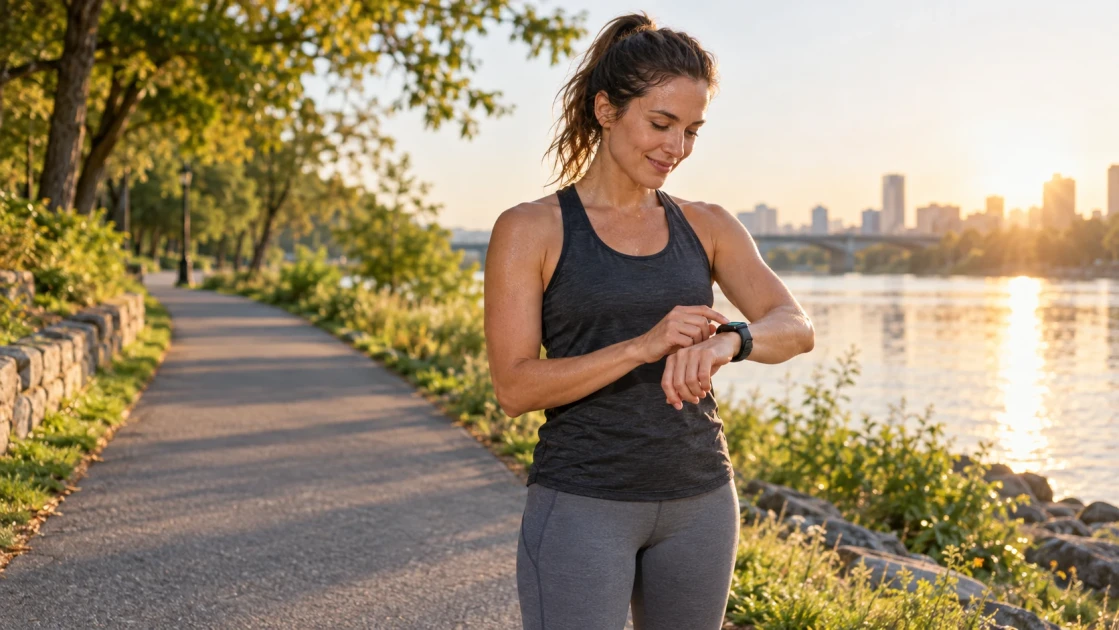
You finish a walk, run or bike session and check the calorie number. It is higher than last time, so the workout must have been better. Or it is lower, and you wonder whether you are losing progress.
A calorie estimate cannot answer whether your endurance is improving. A more useful question is what you completed, under which conditions, and how demanding it felt. Those details let you compare sessions without turning every workout into a calorie target.
Why calories are a weak progress score
Calories describe estimated energy use, not a direct measurement of fitness. Reviews of consumer wearables report variable accuracy in energy-expenditure estimates across devices and activities (Fuller et al., 2020; Doherty et al., 2024).
Even an accurate energy-use figure would not tell the whole story. Training longer can raise the total without showing that you can cover the same route more comfortably. A different device or changed settings can also make the displayed numbers difficult to compare.
You can keep calories as optional context. Avoid treating a bigger number as a better session, or a smaller number as proof of improved efficiency. Choose a measure that reflects the ability you actually want to develop.
Choose the comparison that matches your goal
Three simple comparisons can make a cardio diary more informative:
- More distance in the same time: useful when you want to move faster at a similar, manageable effort.
- Less time for the same distance: useful when a familiar route or event distance matters to you.
- The same work with less effort: useful when you want a regular walk, ride or run to feel more comfortable.
Keep these separate from consistency and training volume. Completing your planned sessions is progress in your routine. Increasing weekly minutes means you did more activity. Neither automatically proves improved fitness, although both may support your goals.
Start with the activity, date, actual duration and distance where available. Speed can help too. Speed is distance per time, such as kilometres per hour; pace is time per distance, such as minutes per kilometre. Higher speed is faster, while a smaller pace value is faster. Our guide to tracking workout progress explains the broader recording habit.
Make the sessions comparable
A faster result becomes meaningful only when you know what changed. Before comparing, check:
- Activity and equipment: compare walking with walking, and use the same treadmill or stationary bike when possible. Displayed distance or resistance levels on different machines are not automatically equivalent.
- Route and conditions: consider hills, surface, wind and temperature. A flat route and a hilly route are different tasks.
- Time definition: use the same rule for stops and pauses, and distinguish the main activity from warm-ups and cooldowns.
- Measurement source: keep the same method where practical, and flag a changed device or a distance reading that appears unreliable.
- Session purpose: compare steady sessions with steady sessions. An interval session with recovery periods answers a different question.
For a stationary bike, the same displayed speed can involve different resistance. If you cannot keep or describe the resistance consistently, a speed comparison alone is weak evidence. Likewise, a whole-session average can hide harder intervals and longer recovery periods.
You do not need perfect laboratory conditions. You need enough context to avoid mistaking a different task for an improvement. Keep the comparison submaximal and repeatable rather than turning every outing into a maximum-effort test.
Add effort to the numbers
Describe whether the work felt easy, moderate or hard, using the same interpretation each time. For continuous cardio, effort means the overall demand of the activity; it is not the number of strength repetitions left in reserve.
The talk test offers a simple intensity cue: moderate activity generally allows conversation but not singing; vigorous activity allows only a few words before a breathing pause (CDC). It is an approximate guide, not a precise fitness test.
If you already monitor heart rate, treat it as supporting context. A lower reading during comparable work may be useful, but temperature, stress, medication and measurement differences can also affect it. One lower reading does not establish better fitness. You do not need heart-rate data to begin keeping useful records.
A practical comparison without a calorie target
Imagine someone comparing a comfortable walking segment on the same flat loop, with the same measurement method and similar conditions. These figures illustrate the comparison, not a pace prescription:
- Earlier sessions: 20 minutes, 2.0 kilometres, average speed 6.0 kilometres per hour, with conversation still possible.
- Later comparable sessions: 20 minutes, 2.1 kilometres, average speed 6.3 kilometres per hour, with a similar perceived effort and ability to talk.
The later segment covers 0.1 kilometre more in the same time. That is five percent more distance, not proof of a five percent increase in fitness. If the pattern repeats under comparable conditions, it is useful evidence of improved performance at that reported effort.
If the later walk required much harder effort, the comparison changes: the person went faster, but has not demonstrated the same improvement at a matched effort. If the route, stops or distance measurement changed, resolve those differences before drawing a conclusion.
Another worthwhile outcome would be completing the original 20-minute, 2.0-kilometre segment with consistently less effort. The calorie display does not need to rise for that change to matter.
Record the actual cardio in Smart Workout Diary
Smart Workout Diary can record duration, distance and speed when those measurements are supported by the exercise. Give units explicitly and distinguish the activity you actually completed from a future target. A continuous segment can be recorded as one entry; keep intentional intervals distinguishable when that detail matters.
For the earlier walking example, a text or voice request could be:
Today I completed one continuous outdoor walking segment: 20 minutes, 2 kilometres, average speed 6 kilometres per hour. These figures cover the main segment only, excluding warm-up and cooldown. I have not logged it yet. Record it once and do not change my training plan.
Check the saved activity, date, duration, distance, speed and units. The numbers above agree: 2 kilometres in one third of an hour equals 6 kilometres per hour. Do not combine a main-segment distance with the elapsed time of the whole outing.
If distance or speed is unknown, say so rather than inventing a value. A known duration is still useful. If speed is calculated from distance and time, both must describe the same segment and use a consistent treatment of stops.
When using Active Workout Mode, check actual measurements before marking the activity complete; planned values are not necessarily your results. If the work is already saved, avoid adding it again through the coach. Our guide to logging workouts by voice explains how to make those requests clear.
The app also supports estimated calories, and AI-assisted logging can include an estimate. Treat it as an estimate rather than a measured fitness score. Effort, weather, route details and readings from other devices should be explained when relevant; do not assume they are stored as structured workout measurements or available automatically during a later review.
Review a period, not just the best result
Ask the coach to review a specific period and separate comparable activities. Explain the conditions and effort you remember, including exceptions. A useful request might be:
Review my recorded outdoor walks from the last four weeks. Compare duration, distance and any recorded speed, keeping the 20-minute main segments separate from other walks. I used the same flat loop and could maintain conversation, except for one windy session that felt harder. Ask which session that was and what other context is missing. Do not treat estimated calories as evidence of improved fitness, change my plan or add completed activity.
Look for a repeated pattern rather than selecting only the fastest result. The coach can compare saved measurements, but it cannot reconstruct missing conditions or know how you felt from a completion marker. Provide important context again when needed.
Keep the questions distinct: did you train consistently, did the amount of activity change, and did comparable performance or effort improve? Adding the minutes of walks and rides can describe total activity time, but it does not make their distances or speeds directly comparable.
Use the trend to choose one next step
If your current work is repeatable and fits your recovery, choose a change that suits your goal. You could extend one session, make a modest speed change or keep the workload while improving consistency. There is no need to increase every measure or chase a new best each week.
The AI coach can change a selected cardio session while preserving other training. Request that edit separately from logging or analysis, and say which days, exercises and targets should stay unchanged. If duration, distance and speed are all specified, check that they remain consistent after the edit. Our guide to the AI workout planner explains the review-and-adjust process.
When cardio shares the week with lifting, consider how the change affects both. More activity is not useful if it repeatedly makes your priority sessions unmanageable. See our guide to combining strength training and cardio for arranging the week.
Useful cardio tracking connects a result to its conditions and effort. Record what happened, compare similar sessions, and let the trend guide your next adjustment rather than the calorie counter.