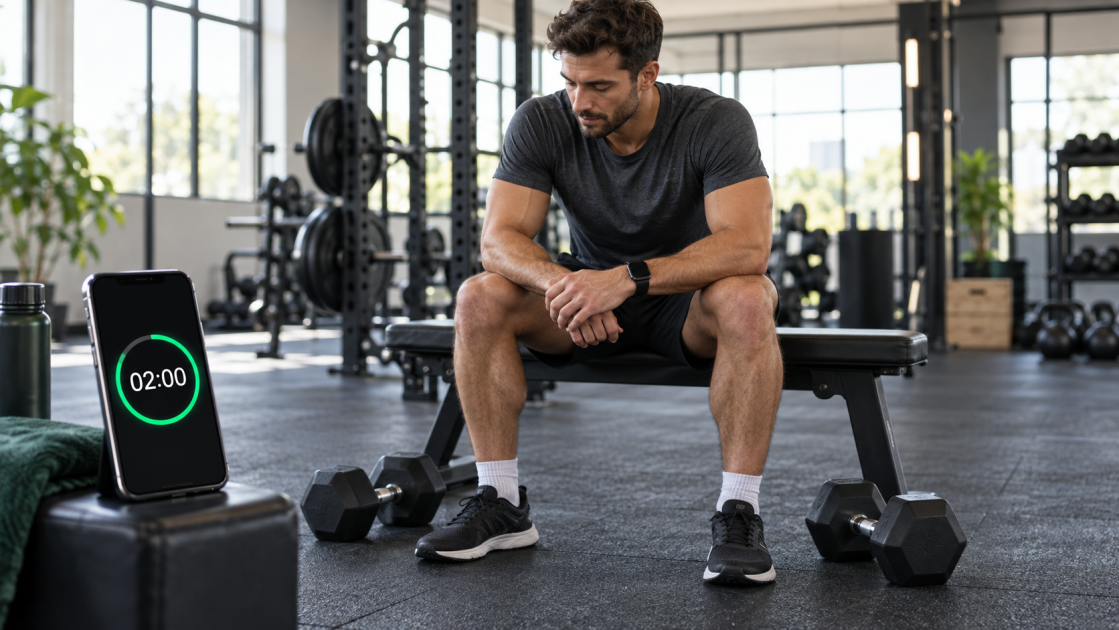
You finish a set, put the weight down, and check the time. Should you start again after 30 seconds, wait two minutes, or take a longer break?
A practical starting point is 2–3 minutes for demanding compound exercises and 1–2 minutes for smaller isolation exercises. For heavy sets focused on maximum strength, allow around 3–5 minutes.
These are starting points, not strict deadlines. The right rest period depends on the exercise, how hard the set was, and what you need to accomplish next.
Why Rest Between Sets Matters
Rest gives you time to recover from the previous effort so you can perform the next set with the intended weight, repetitions, and technique.
Starting too soon can turn a manageable weight into a much harder task. You may lose repetitions or find that your breathing, grip, or general fatigue limits the set before the target muscles do.
The useful question is: How much rest helps me complete the next set well?
Rest Times: A Practical Starting Guide
| Training situation | Starting rest period | What to prioritize |
|---|---|---|
| Heavy strength work, often 1–6 reps | 3–5 minutes | Readiness to repeat a heavy, controlled effort |
| Compound exercises for muscle growth | 2–3 minutes | Maintaining useful repetitions and consistent technique |
| Isolation exercises for muscle growth | 1–2 minutes | Local muscle recovery and set quality |
| Light muscular endurance work | 30–90 seconds | Following the planned endurance demand with good form |
Adjust these ranges to your performance. A difficult set of leg presses may require more recovery than a set of curls, even when both use the same repetition range.
How Long Should You Rest for Strength?
For heavy squats, deadlifts, presses, and similar lifts, start with 3–5 minutes between demanding working sets.
The American College of Sports Medicine's 2009 position stand recommends this range for heavy strength training. It also emphasizes adjusting recommendations to the individual's goals and training status. Read the ACSM position stand.
For example, if your plan calls for four sets of five squats, try a three-minute rest. Before the next set, check whether your breathing has settled enough to brace properly and whether you feel ready to repeat the movement with control.
If you still feel rushed, take another minute and reassess. The timer should help you prepare for the set.
How Long Should You Rest for Muscle Growth?
For muscle growth, begin with 2–3 minutes on compound movements and 1–2 minutes on isolation movements, then adjust as needed.
You do not have to restrict every break to 60 seconds. In an eight-week study of 21 trained young men, three-minute rests produced greater improvements in squat and bench press strength and anterior thigh muscle thickness than one-minute rests. This was a small study, so it does not establish one ideal rest period for everyone. Read the study on one-minute versus three-minute rests.
A practical takeaway is to give yourself enough recovery to preserve productive sets. If a short break repeatedly pushes you below your planned repetition range, experiment with a longer one.
How to Tell Whether You Need More Rest
Look for patterns across several sets and workouts:
- Your repetitions fall sharply despite keeping the same weight.
- You are still too breathless to set up and brace comfortably.
- Your grip or general fatigue limits the next set.
- Your technique becomes difficult to maintain much earlier than expected.
These signs do not prove that rest is the only problem. The weight may be too heavy, the first set may have been too close to failure, or you may simply be having a difficult day.
Try changing one variable at a time. Add 30–60 seconds of rest while keeping the exercise and weight the same, then observe the result.
An Example: Adjusting Rest on the Bench Press
Imagine your target is three sets of 8–10 repetitions. With one-minute breaks, your results are:
- Set 1: 10 reps
- Set 2: 7 reps
- Set 3: 5 reps
At the next comparable session, try resting two to three minutes. Keep the load and technique consistent, and avoid pushing the first set harder than usual.
If you stay closer to your target range, the longer break may suit this exercise better. This is an illustration of how to test your rest period, not a prediction of specific results.
Some repetition loss across sets is normal, particularly when sets are very hard. You do not need identical numbers on every set.
Should Every Exercise Have the Same Rest Time?
A single timer setting is convenient, but an exercise-specific starting point can be more useful.
Here is an example to try and adjust:
- Squat: 3 minutes
- Dumbbell bench press: 2 minutes
- Seated cable row: 2 minutes
- Lateral raise: 90 seconds
- Biceps curl: 90 seconds
These are sample settings, not an optimized prescription. Increase a break when the next set requires it. Even a small isolation exercise can need longer recovery after a particularly demanding effort.
What If You Have Limited Time?
Start by deciding which exercises matter most in today's session. Protect enough recovery for those movements, then fit the remaining work around the time available.
For example, if you have 35 minutes, you might complete your main lifts and fewer optional accessories instead of trying to fit an unchanged hour-long plan into shorter breaks.
Plan equipment changes in advance and keep phone use brief. Those adjustments make the session easier to manage without turning every rest period into a race.
Why Consistent Rest Helps You Track Progress
Suppose you perform eight repetitions after a one-minute rest one week and ten after a four-minute rest the next. The second result is useful, but the conditions have changed.
Keeping rest periods reasonably consistent makes workout comparisons easier to interpret. When you deliberately change them, note it alongside the weight and repetitions.
You do not need to measure every second perfectly. Recording an approximate rest target is often enough to add useful context to your training history.
For more on useful workout records, read How to Track Workout Progress Without Overcomplicating It.
Use a Rest Timer as a Readiness Check
Choose your planned break before the set. Start the timer when the set ends, record your result, and use the remaining time to recover and prepare.
When the timer finishes, check whether you are ready. If you need longer, extend the break and note the adjustment.
Smart Workout Diary's Active Workout mode brings the rest timer into your workout flow. You can read more about it in Active Workout Mode: Stay Focused from First Set to Last.
A Simple Approach for Your Next Workout
- Choose a starting rest period for each exercise.
- Use a timer to keep breaks reasonably consistent.
- Check your readiness before beginning the next set.
- Adjust rest if repetitions or technique deteriorate more than expected.
- Record meaningful changes so future comparisons have context.
Rest long enough to give the next set a fair chance. A useful rest period supports the work you planned and keeps your workout manageable.